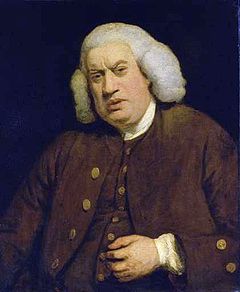
 Johnson's works, especially his Lives of the Poets series, describe various features of excellent writing. He believed that the best poetry relied on contemporary language, and he disliked the use of decorative or purposefully archaic language.In particular, he was suspicious of the poetic language used by Milton, whose blank verse he believed would inspire many bad imitations. Also, Johnson opposed the poetic language of his contemporary Thomas Gray.His greatest complaint was that obscure allusions found in works like Milton's Lycidas were overused; he preferred poetry that could be easily read and understood. In addition to his views on language, Johnson believed that a good poem incorporated new and unique imagery
Effie913 發表在 痞客邦 留言(0) 人氣(12)
1667 Jonathan Swift born on November 30 in Dublin, Ireland; the son of Anglo-Irish parents. His father dies a few months before Swift is born.
1673 At the age of six, Swift begins his education at Kilkenny Grammar School, which was, at the time, the best in Ireland.
1682-1686 Swift attends, and graduates from, Trinity College, Dublin
1688 William of Orange invades England, initiating the Glorious Revolution in England. With Dublin in political turmoil, Trinity College is closed, and Swift goes to England.
Effie913 發表在 痞客邦 留言(0) 人氣(64)
Some information about The Pilgrim's Progress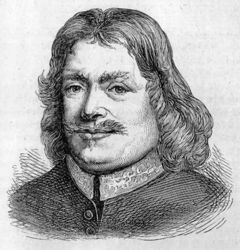 Bunyan wrote The Pilgrim's Progress in two parts, the first of which was published in London in 1678 and the second in 1684. He began the work in his first period of imprisonment, and probably finished it during the second. The earliest edition in which the two parts combined in one volume came in 1728. A third part falsely attributed to Bunyan appeared in 1693, and was reprinted as late as 1852. Its full title is The Pilgrim's Progress from This World to That Which Is to Come.
 Effie913 發表在 痞客邦 留言(0) 人氣(8)
We've already learned some poems of John Milton, and his poem to his dead wife is very beautiful. Although he was almost blind; his words to describe the miss to his wife is very touching to me
The following information is timeline of John Milton's life
and I also found some websites about him, and I hope you can all enjoy it.
http://www.eng.fju.edu.tw/English_Literature/englit_1/milton.htm
Effie913 發表在 痞客邦 留言(0) 人氣(10)
Poetry by Robert Herrick - To Electra
I dare not ask a kiss, a
I dare not beg a smile, b
Lest having that, or this, a
I might grow proud the while. b
No, no, the utmost share c
Of my desire shall be d
Only to kiss that air c
That lately kissed thee. d
Effie913 發表在 痞客邦 留言(0) 人氣(13)
There is a Garden in her face, a
Where Roses and white Lillies grow ; b
A heav'nly paradise is that place, a
Wherein all pleasant fruits doe flow. b
There Cherries grow, which none may buy b
Till Cherry ripe themselves doe cry. c
Those Cherries fairly doe enclose
Of Orient Pearle a double row ;
Which when her louely laughter showes,
They look like Rose-buds fill'd with snow.
Yet them nor Peere nor Prince can buy,
Till Cherry ripe themselues doe cry.
Effie913 發表在 痞客邦 留言(0) 人氣(8)

Sonnet 130
Effie913 發表在 痞客邦 留言(0) 人氣(23)
In England, there are two main religion.
One is Catholic and the other one is Christian.
These two religion had conflict most of the time during the early seventeenth centry; eventually led to the Gunpowder.
Effie913 發表在 痞客邦 留言(0) 人氣(8)
 The earlier seventeenth century, and especially the period of the English Revolution (1640–60), was a time of intense ferment in all areas of life — religion, science, politics, domestic relations, culture. That ferment was reflected in the literature of the era, which also registered a heightened focus on and analysis of the self and the personal life. However, little of this seems in evidence in the elaborate frontispiece to Michael Drayton's long "chorographical" poem on the landscape, regions, and local history of Great Britain (1612), which appeared in the first years of the reign of the Stuart king James I (1603–1625). The frontispiece appears to represent a peaceful, prosperous, triumphant Britain, with Engla nd, Scotland, and Wales united, patriarchy and monarchy firmly established, and the nation serving as the great theme for lofty literary celebration. Albion (the Roman name for Britain) is a young and beautiful virgin wearing as cloak a map featuring rivers, trees, mountains, churches, towns; she carries a scepter and holds a cornucopia, symbol of plenty. Ships on the horizon signify exploration, trade, and garnering the riches of the sea. In the four corners stand four conquerors whose descendants ruled over Britain: the legendary Brutus, Julius Caesar, Hengist the Saxon, and the Norman William the Conqueror, "whose line yet rules," as Drayton's introductory poem states.
 Effie913 發表在 痞客邦 留言(0) 人氣(8)
 The sixteenth century in Europe was a time of unprecedented change. It was the beginning of the modern era,
Effie913 發表在 痞客邦 留言(0) 人氣(31)
